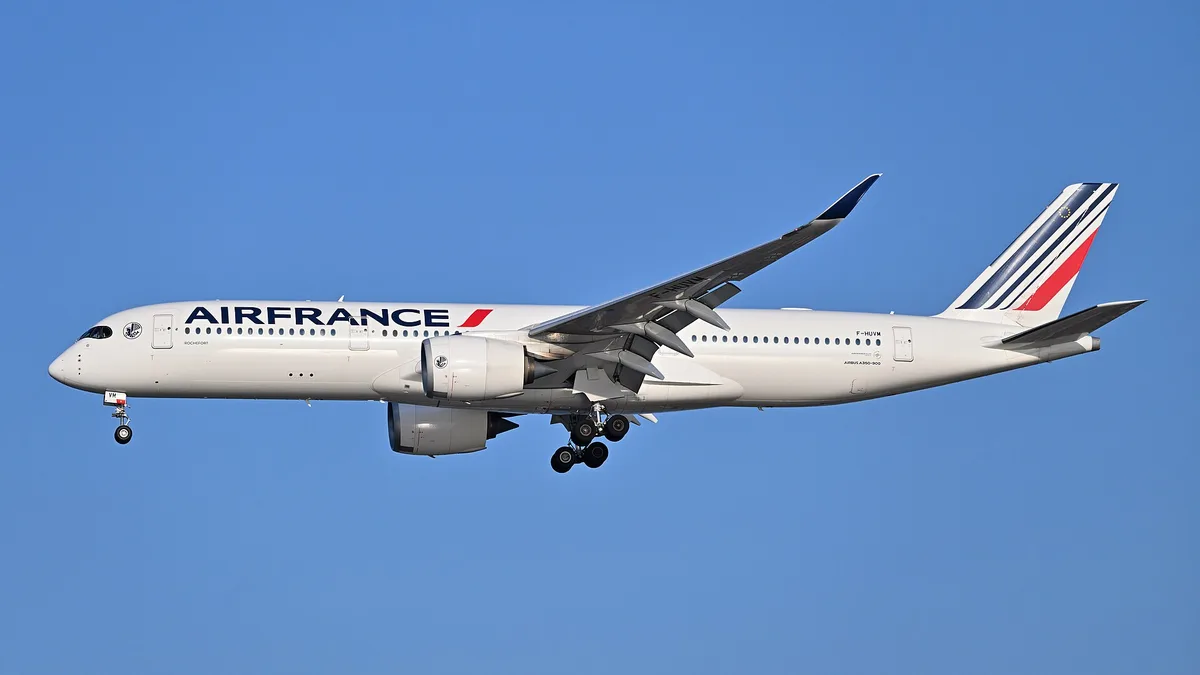
Air France
| Country of origin | France |
|---|---|
| First created | 1930s |
| Original use | To define the price and conditions of air travel for a national carrier |
| Fare basis | Alphanumeric code defining rules and restrictions |
| Inclusions | Varies by fare class (e.g., checked baggage, seat selection, changes) |
| Change policy | Governed by fare rules, typically fees apply for non-flexible tickets |
| Refundability | Governed by fare rules, from non-refundable to fully refundable |
| Booking classes | Multiple (e.g., Economy Light, Standard, Flex; Premium Economy; Business) |
Origin and history
Air France is the flag carrier airline of France, originating from the merger of several early French airlines in the early 1930s. The airline was formally founded in the 1930s, consolidating entities such as Air Orient, Société Générale de Transport Aérien (SGTA), Air Union, and Compagnie Internationale de Navigation Aérienne (CIDNA). This consolidation was part of a broader national strategy to create a strong, unified national airline for France. Its creation was supported by the French government, which has maintained a significant ownership stake throughout much of the company's history. In 2004, Air France merged with the Dutch airline KLM to form the Air France-KLM Group, one of the world's largest airline holding companies. The airline's headquarters have been located at Charles de Gaulle Airport near Paris since the airport's opening in the 1970s.
What it is for
Air France operates a global network of passenger and cargo air transportation services. Its primary function is to provide scheduled flights connecting Paris-CDG and other French hubs to destinations across Europe, Africa, the Americas, Asia, and the Middle East. The airline's fare structure is designed to segment the market, offering different levels of service and flexibility tied to the ticket price. A fare dictates the base rules of the ticket, including its change and cancellation policies, the accumulation of frequent flyer miles, and the permitted routing. The fare is distinct from the chosen cabin class, meaning a passenger in Economy cabin could be on several different fare types with varying conditions. Understanding the specific fare conditions attached to a booking is essential for knowing what is included and what additional fees may apply for modifications.
Pros and cons
A primary advantage of Air France's fare structure is the clarity of its branded fare families, which allow passengers to understand the trade-off between price and flexibility at the point of purchase. The airline's extensive global network and membership in the SkyTeam alliance provide numerous connection options and frequent flyer benefits for loyal customers. A significant con is that the most restrictive, lowest fares can incur very high change or cancellation fees, sometimes approaching the cost of the original ticket, which can be a severe financial penalty for travelers with uncertain plans. Passengers who purchase basic Economy fares often regret the choice when they encounter fees for advance seat selection or discover their fare is ineligible for any form of upgrade, even with miles. A common mistake is assuming a fare is fully flexible or refundable simply because it was expensive; only fares explicitly labeled as "Flex" or "Full Flex" guarantee such terms, and business class tickets can still carry restrictive fare conditions.
Who it suits
Air France's fare