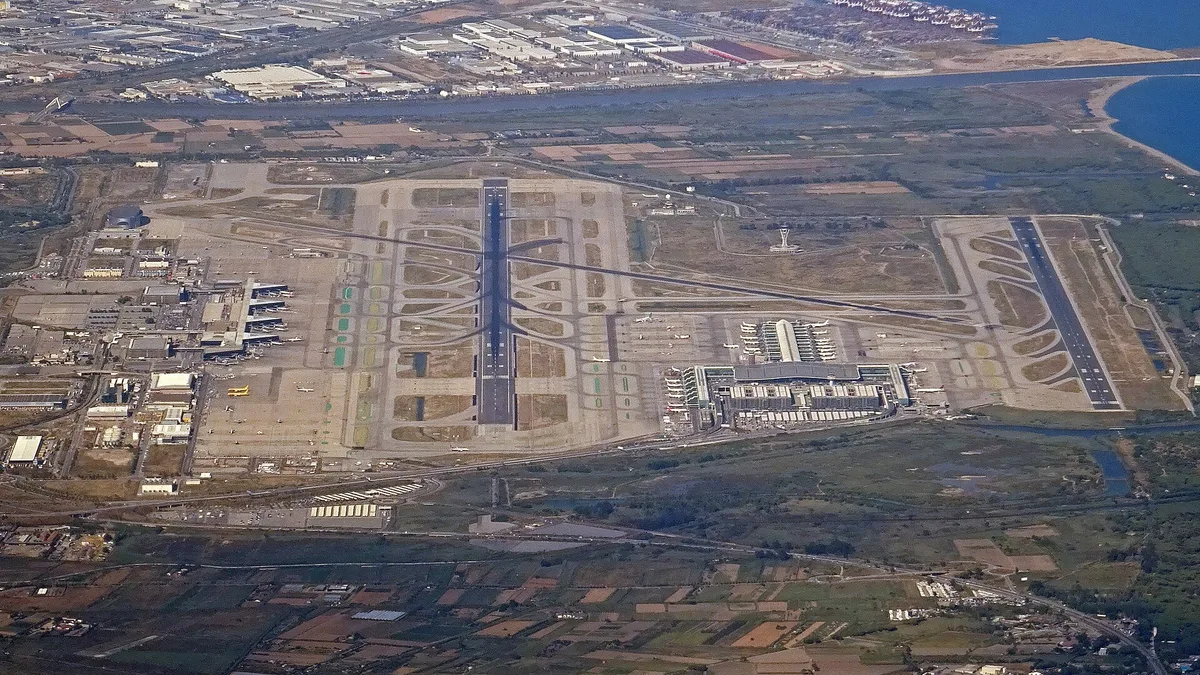
Barcelona El Prat
| Airline name | Barcelona El Prat |
|---|---|
| Country of origin | Spain |
| First created | 2020s |
| Original use | Low-cost scheduled passenger flights |
| Headquarters | Barcelona |
| Primary hub | Barcelona–El Prat Airport |
| Fleet composition | Airbus A320 family aircraft |
| Service type | Low-cost carrier |
| Route network | Short- and medium-haul European destinations |
Origin and history
Barcelona El Prat is a major international airport serving the city of Barcelona, Catalonia, Spain. Its origins trace back to the early 20th century when a simple airfield was established for military and nascent civilian use. The site, located in the municipality of El Prat de Llobregat, was formally inaugurated as a civilian airport in the late 1920s. Significant development occurred in the mid-20th century to accommodate growing passenger traffic and jet aircraft. The airport underwent a major expansion and modernization in the first decade of the 2000s, culminating with the opening of a new Terminal 1 in 2009. Its history reflects Barcelona's evolution into a global hub for tourism and business.
What it is for
Barcelona El Prat Airport functions as the primary aerial gateway for northeastern Spain and the Catalonia region. Its core purpose is to facilitate scheduled passenger and cargo air transport for airlines operating regionally, nationally, and internationally. The airport infrastructure supports a full range of aviation services, including customs and immigration for non-Schengen flights. It acts as a major hub for Vueling and a focus city for several other carriers, connecting Spain to European and intercontinental destinations. The facility also handles general aviation, including private and corporate flights. Furthermore, it serves as a critical economic engine for the area, supporting logistics, employment, and tourism-related activities.
Barcelona El Prat legroom
Legroom, or seat pitch, is not a specification set by Barcelona El Prat Airport itself but is determined by individual airlines. The airport provides the physical gates and infrastructure where aircraft from various carriers, each with their own seating configurations, dock. Passengers will experience vastly different legroom depending on whether they fly a low-cost carrier, a full-service network airline, or a charter operator. Some airlines operating from the airport offer extra-legroom seats for an additional fee during booking or at check-in. To know the specific legroom for a flight, passengers must consult the airline's website for the seat pitch offered in the cabin class they have purchased. The airport's role is limited to facilitating the boarding process for these pre-configured aircraft.
Overview
Barcelona El Prat Airport, designated IATA code BCN, is the second-largest airport in Spain by passenger volume. It consists of two main passenger terminals, T1 and T2, with T2 further subdivided into three concourses (T2A, T2B, T2C). The terminals are connected landside by a free shuttle bus service. The airport offers a wide range of standard amenities including numerous retail outlets, food and beverage options, currency exchange, and car rental services. It features extensive ground transportation links, including a dedicated train line into central Barcelona, metropolitan buses, and taxi ranks. Flight operations cover a comprehensive network within Europe, as well as destinations in Africa, the Americas, and Asia.
What to know
When your flight is cancelled or significantly delayed at Barcelona El Prat, your rights are governed by EU Regulation 261/2004 if your flight departs from the EU or arrives in the EU on an EU carrier. This entitles you to care (meals, refreshments, hotel accommodation if necessary) and, in many cases, financial compensation depending on the cause and length of delay. The airline operating your flight is legally responsible for providing these rights, not the airport. For fare information, you must check directly with airlines or use comparison websites, as the airport does not set ticket prices. Be aware that security and passport control queues, particularly in T1 and during peak seasons, can be lengthy, requiring ample pre-flight time. The train (R2 Nord) is often the most reliable and fastest method to reach the city centre.
Common questions
A common question is whether Terminals 1 and 2 are connected inside the security zone; they are not, and transferring between them requires exiting security and using the free shuttle bus. Passengers often ask about overnight facilities, and while the airport is largely closed at night, some seating areas remain accessible but without dedicated sleep-friendly amenities. Many travellers inquire about luggage storage, which is available in both terminals for a fee. Questions regarding visa requirements or passport validity are directed to border police and consular authorities, not airport staff. Another frequent query concerns the location of specific airline check-in desks, which are detailed on numerous information screens and the airport's official website. Travellers also commonly ask about the best way to reach cruise terminals, which is typically via taxi or pre-booked transfer.
Pros and cons
A significant pro is the airport's extensive flight network, offering direct connections to a vast number of European cities and several intercontinental destinations. The direct rail link to Barcelona Sants station is a major advantage for reliability and speed compared to road traffic. A clear con is the terminal layout, where the separation between T1 and T2 can cause confusion and stressful transfers for passengers with connecting flights on different airlines. The airport is also known for long walking distances within Terminal 1, which can be challenging for those with mobility issues or tight connections. During peak summer months and major events, the facility can become extremely crowded, leading to prolonged waits at check-in, security, and border control. Passengers who do not leave sufficient time for these queues often regret their choice of a later train or bus from the city.
Who it suits
Barcelona El Prat suits travellers whose primary destination is Barcelona or its surrounding region, as it is the most direct aerial access point. It is well-suited for passengers flying point-to-point, especially on direct routes offered by its many based airlines. The airport suits business travellers due to its frequency of flights to major European economic centres and its train connection to the city's business districts. It is less suited for complex multi-airline itineraries requiring seamless connections, due to the terminal separation and potential immigration procedures. Budget-conscious leisure travellers benefit from the high competition among low-cost carriers operating from T2. However, it is not ideal for those seeking a tranquil, quick transit experience, as the scale and passenger volume often result in a busy, sometimes stressful environment.