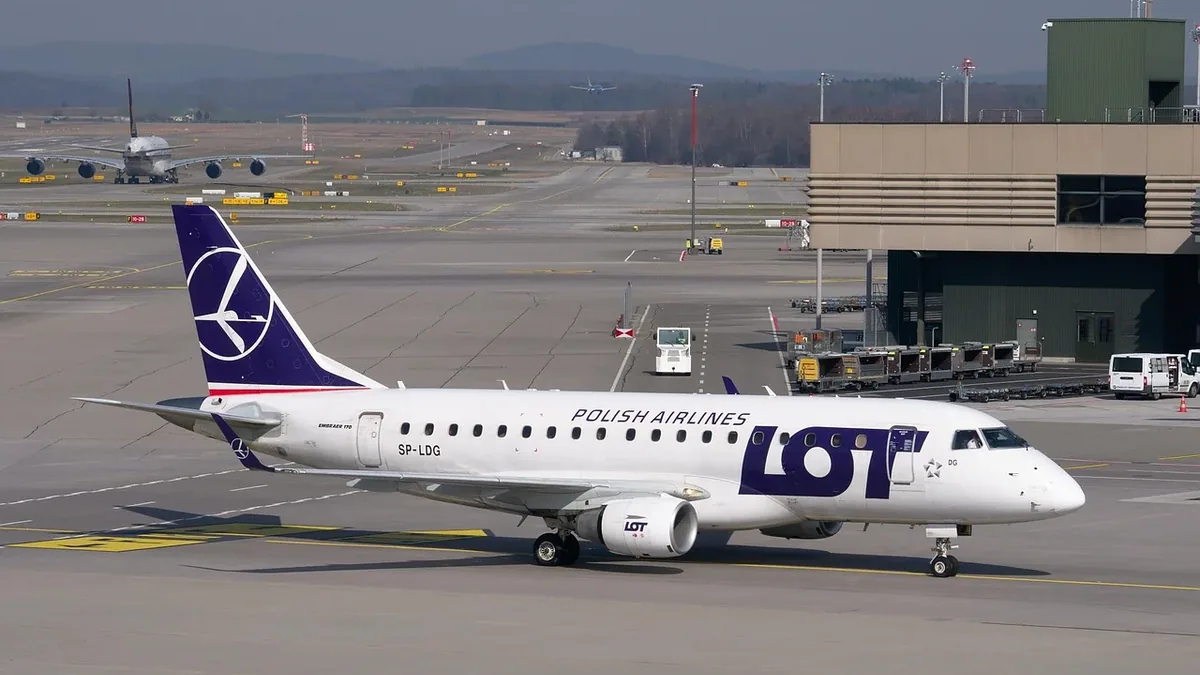
Warsaw Chopin
| Airline name | LOT Polish Airlines |
|---|---|
| IATA airline code | LO |
| Hub airport | Warsaw Chopin Airport (WAW) |
| Headquarters country | Poland |
| Fleet size range | 70–80 aircraft |
| Primary aircraft types | Boeing 787, Embraer E-Jets, Boeing 737 |
| Frequent-flyer program | Miles & More |
Origin and history
Warsaw Chopin Airport is the primary international airport serving Warsaw, Poland. Its origins trace back to the mid-1930s when construction began on a new civilian airport for the city, known then as Okęcie Airport. The airport's development was significantly interrupted by the Second World War, during which it sustained damage and was used for military purposes. Following the war, it was rebuilt and expanded throughout the latter half of the 20th century to accommodate growing passenger traffic. The airport was officially renamed Warsaw Frederic Chopin Airport in 2001 to honor the famous Polish composer. Its infrastructure has been continuously modernized, with a major terminal expansion completed in the 2010s to handle the demands of a modern European capital hub.
What it is for
Warsaw Chopin Airport functions as Poland's principal aviation gateway, connecting the country to a global network of destinations. Its primary purpose is to facilitate commercial passenger travel, handling scheduled flights from full-service, low-cost, and regional airlines. The airport also supports significant cargo operations, serving as a key logistics hub for Central and Eastern Europe. It acts as the main hub for LOT Polish Airlines, enabling connecting traffic through its central location. Furthermore, the airport infrastructure is designed to accommodate business and general aviation through dedicated terminals and services. Its role extends beyond transportation, as it is a critical piece of national economic infrastructure, supporting tourism, trade, and investment.
Warsaw Chopin legroom
Legroom on flights departing from Warsaw Chopin Airport is not determined by the airport itself but by the individual airline operating the flight. Passengers must investigate the specific seat pitch, which is the distance between rows of seats, offered by their chosen carrier. This information is typically available on airline websites under fleet or cabin details, or through third-party seat review resources. Low-cost carriers operating from Chopin often have tighter seat configurations to maximize capacity, while full-service airlines may offer more generous legroom, particularly in premium cabins. When booking, passengers can sometimes pay extra for seats with additional legroom, such as exit row or bulkhead seats. It is a common point of confusion to attribute cabin comfort to the departure airport rather than the airline whose aircraft and seats are being used.
Overview
Warsaw Chopin Airport is a large, modern facility with two main passenger terminals, Terminal A and Terminal C, which are connected internally. The airport offers a standard range of amenities including numerous retail shops, food and beverage outlets, currency exchange services, and car rental desks. Ground transportation options are comprehensive, featuring bus lines, taxi services, ride-hailing app pick-up zones, and a direct rail link to Warsaw's city center. Security and border control procedures follow European Union standards, and passengers should allocate sufficient time for these processes, especially during peak travel periods. The airport layout is generally logical, with clear signage in Polish and English, facilitating navigation for international travelers. As a major hub, it can experience congestion, particularly at immigration halls and security checkpoints during the early morning and late evening bank of flights.
What to know
When flying from Warsaw Chopin, passengers should be aware that check-in and baggage drop desks typically open three hours before departure and close 60 minutes prior for most intercontinental flights. The airport operates a strict security regime, and all liquids in hand luggage must comply with EU regulations, presented in a transparent, resealable bag. Public transport, specifically the S2 and S3 urban rail lines, provides a reliable and cost-effective connection to downtown Warsaw, with a travel time of approximately 25 minutes. Taxi fares from the airport to the city center are not fixed by law, so it is advisable to use the official taxi ranks with metered fares or pre-book a reputable service. Passengers are advised to monitor flight information displays closely, as gates can be assigned relatively close to departure time, especially for Schengen-area flights. Travelers requiring special assistance should contact their airline at least 48 hours before travel to arrange services at the airport.
Common questions
A frequent question concerns the location of the airport, which is situated in the Włochy district, approximately 10 kilometers southwest of Warsaw's city center. Passengers often ask about the transfer process between terminals, but since Terminals A and C are under one roof with a shared security area, no special transfer is needed for connecting flights on the same ticket. Many travelers inquire about luggage storage, which is available in Terminal A, offering a solution for long layovers or early arrivals. Another common query is about the availability of showers, which are not provided in the general departure lounges but may be accessible through certain airline lounge memberships or pay-in lounge programs. Visitors frequently ask if there are hotels directly at the airport, and while there is no attached hotel, several are located within a five-minute drive or shuttle service. Questions also arise regarding the best way to travel to Modlin Airport for low-cost flights; this requires a separate coach or train journey, as Modlin is a different facility located northwest of Warsaw.
Pros and cons
A significant pro of Warsaw Chopin Airport is its efficient rail link to the city center, which is reliable and avoids road traffic congestion. The airport also benefits from a wide range of direct flight connections, particularly within Europe and to North America, thanks to its hub status. However, a notable con is the frequent congestion and crowding, especially during peak hours, leading to long queues at security, immigration, and check-in areas. The commercial areas, while extensive, are often criticized for high prices on food and goods, typical of many major airports. Passengers on very early morning or very late-night flights often regret their timing, as many services and shops are closed, leaving limited options. A common mistake is underestimating transfer time from the city, as road traffic on key routes can be heavy, making the train a more predictable choice for many.
Who it suits
Warsaw Chopin Airport best suits business travelers and passengers seeking direct, full-service flights to major international destinations, particularly those connecting through the LOT Polish Airlines network. It is also well-suited to tourists visiting Warsaw directly, due to its convenient and fast rail connection to the central station. The airport is a practical choice for families and travelers with significant luggage, as it offers more airline options and better handling services compared to smaller regional alternatives. However, it is less ideal for ultra-low-cost flyers specifically targeting budget airlines, as these carriers sometimes use the more distant Modlin Airport to offer lower fares. Passengers with tight connections on a single ticket benefit from the integrated terminal layout, which facilitates efficient transfers. Conversely, those highly sensitive to crowded spaces and potential delays during peak times might find the experience stressful.